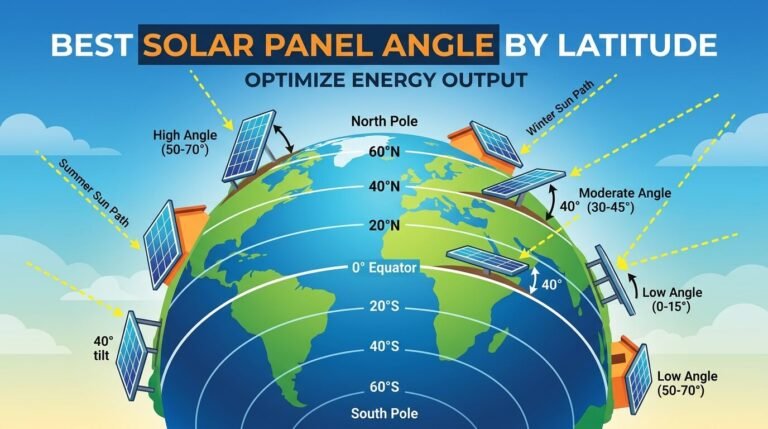

Best Angle for Solar Panels: Why Your Latitude Decides Everything
Ask ten installers for the best angle for solar panels and you’ll get a range of confident answers. Ask a solar engineer and you’ll get one question back:
“What’s your latitude?”
That single number — how many degrees you sit north or south of the equator — determines your ideal panel angle more than your roof, your climate, or your hardware. Everything else is a refinement.
This guide gives you the rule, the math behind it, the tables to apply it in your region, and — because honest guides admit this part — the five situations where the rule quietly breaks.
By the end, you’ll be able to check any installer’s proposal against real numbers in about thirty seconds.
Key Takeaways
- The best angle for solar panels roughly equals your latitude. A home at 35°N performs best near 35° of tilt.
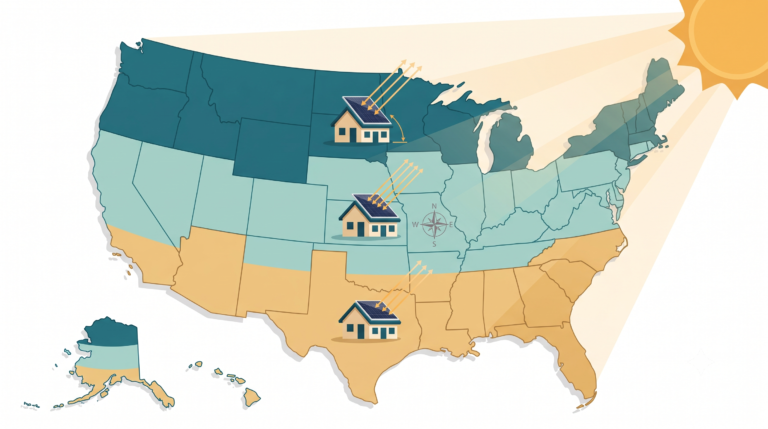
- Most US homes land between 30° and 45°, because the continental US spans roughly 25°N to 49°N.
- The rule exists because latitude fixes the sun’s average height in your sky — panels tilt to meet it head-on.
- Refinements like latitude × 0.9 shift the balance slightly toward summer, but the difference is under 2% annually.
- Being within 5° of your target costs about 1% of output. Within 15°, flush-mounting to your existing roof usually beats paying for racking.
- The rule bends in five cases: heavy cloud cover, snow country, time-of-use billing, equatorial locations, and winter-dependent off-grid systems.
The Quick Answer
The best angle for solar panels is approximately equal to your latitude, with panels facing true south in the Northern Hemisphere and true north in the Southern Hemisphere. A home at 40°N should tilt panels near 40°. Most US installations perform best between 30° and 45°, with steeper angles favoring winter production and flatter angles favoring summer.
That’s the answer Google will show in a snippet. Here’s the part that makes it useful: why it works, and when it doesn’t.
Why Latitude Decides Everything
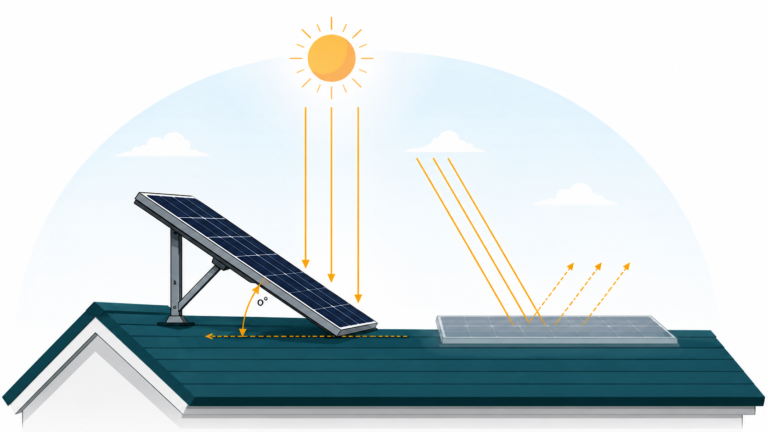
If you’re brand new to panel positioning, it helps to first learn what solar panel tilt angle means — the short version is that panels produce maximum power when sunlight strikes the glass at a perfect right angle.
The question, then, is where the sun actually sits in your sky. And that’s pure geometry.
The Sun’s Height Is a Function of Your Latitude
At solar noon on the spring or fall equinox, the sun’s height above your horizon follows one clean formula:
Sun’s noon altitude = 90° − your latitude
Live in Miami at 26°N? The equinox noon sun stands 64° above your horizon — high and blazing. Live in Seattle at 47.6°N? That same sun reaches only 42.4° — barely halfway up the sky.
Now flip the geometry around. For sunlight to hit your panel at a perfect right angle, the panel must tilt away from horizontal by exactly the amount the sun falls short of overhead. The sun sits (your latitude) degrees away from directly overhead on average. So the panel tilts (your latitude) degrees.
That’s the entire rule. Tilt equals latitude, because tilt is latitude, expressed as hardware.
The Seasons Swing Around That Average
Earth’s 23.45° axial tilt makes the noon sun climb higher than the equinox position in summer and sink lower in winter — a total swing of roughly 47° over the year.
Your latitude-based angle is the center of that swing. It’s not perfect for June and not perfect for December. It’s the compromise that loses the least across all twelve months, which is exactly what a fixed installation needs.
The Latitude Rule and Its Refinements
Engineers have proposed several versions of the rule over the decades. Here’s what each one actually changes:
| Formula | Angle at 40°N | What It Optimizes |
|---|---|---|
| Tilt = latitude | 40.0° | Balanced year-round baseline |
| Tilt = latitude × 0.9 | 36.0° | Slight summer bias (more annual kWh in sunny climates) |
| Tilt = latitude − 2.5° | 37.5° | Similar mild summer bias, older rule of thumb |
| Tilt = latitude × 0.87 + offset | ~37–39° | Empirical fit validated against irradiance databases |
Look at the spread: every version lands within about 4° of plain latitude. And since 5° of error costs roughly 1% of output, the honest conclusion is that the refinements are footnotes, not corrections.
Why do the refined formulas lean flatter? Two reasons. Summer days are longer, so there are simply more summer photons to collect. And atmospheric scattering means some light arrives from the whole sky rather than the sun’s disk — flatter panels see more sky.
The practical takeaway: start with your latitude. If you want to squeeze out the last fraction of a percent, shave a few degrees off. Don’t lose sleep either way.
Best Solar Panel Angle by Latitude Band
Find your band, read your range:
| Latitude Band | Example Regions | Best Year-Round Angle |
|---|---|---|
| 20–25°N | Hawaii, southern Mexico, UAE | 20–25° |
| 25–30°N | South Florida, South Texas, Gulf Coast | 25–30° |
| 30–35°N | Atlanta, Dallas, Phoenix, Los Angeles | 30–35° |
| 35–40°N | Nashville, Denver, Las Vegas, Washington DC | 35–40° |
| 40–45°N | New York, Chicago, Salt Lake City, southern Europe | 40–45° |
| 45–50°N | Seattle, Minneapolis, Toronto, central Europe | 45–48° |
| 50°N+ | UK, Germany, southern Canada | 40–45° (see the cloud exception below) |
Notice the last row breaks the pattern. That’s not a typo — it’s the first place the latitude rule bends, and we’ll get to it shortly.
Quick City Reference
| City | Latitude | Best Angle |
|---|---|---|
| Miami, FL | 25.8°N | 26° |
| Austin, TX | 30.3°N | 30° |
| Phoenix, AZ | 33.4°N | 33° |
| Denver, CO | 39.7°N | 40° |
| Chicago, IL | 41.9°N | 42° |
| Seattle, WA | 47.6°N | 48° |
| London, UK | 51.5°N | ~40° |
| Sydney, AU | 33.9°S | 34° (facing true north) |
Not listed? You don’t need to interpolate by hand — find your exact tilt angle instantly by entering your coordinates, and you’ll get your annual, seasonal, and monthly angles plus the correct facing for your hemisphere.
Seasonal Angles: A Preview of the Adjustment Game
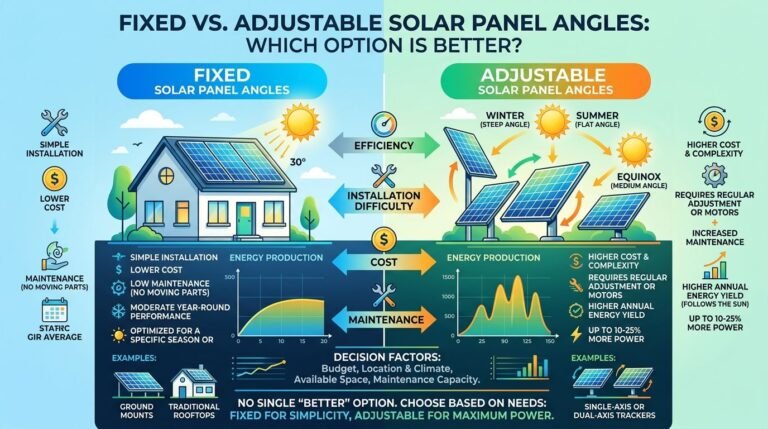
If your mounting system allows angle changes, the standard seasonal offsets are:
- Winter: latitude + 15° (steeper, to meet the low sun)
- Summer: latitude − 15° (flatter, because the sun rides high)
- Spring/Fall: latitude (the sun sits at its average height)
A Denver homeowner at 39.7°N would run roughly 55° in December and 25° in June.
Is the adjustment worth the effort? For rooftops, almost never — a fixed mount at the year-round angle captures 96–98% of what seasonal changes would deliver. For ground mounts and RV arrays at arm’s reach, twice-yearly changes add a real 4–5%. The full seasonal playbook gets its own article later in this series.
The Five Cases Where the Latitude Rule Fails
This is the section most “best angle” articles skip, and it’s where the real expertise lives. The latitude rule assumes clear skies, snow-free glass, and a grid that pays the same for every kilowatt-hour. Break any assumption and the best angle moves.
1. Heavy Cloud Cover Favors Flatter Angles
In cloudy climates, a large share of your light arrives as diffuse radiation — scattered across the entire sky dome rather than beaming from the sun’s position. A flatter panel “sees” more sky, so it collects more diffuse light.
This is why London at 51.5°N optimizes near 40° instead of 51°. The European Commission’s PVGIS database, built from decades of satellite irradiance data, confirms optimal UK angles of roughly 35–42° — well below raw latitude. The same logic trims a few degrees off the Pacific Northwest.
Rule adjustment: in persistently cloudy regions, subtract 5–10° from your latitude.
2. Snow Country Favors Steeper Angles
Every output table assumes clean glass. A panel buried under snow produces zero, no matter how “optimal” its angle looks on paper.
Steeper panels shed snow dramatically faster — often within hours of a storm instead of days. In heavy-snow regions, an angle 5–10° above latitude frequently outproduces the theoretical optimum simply by staying uncovered through the highest-value clear days that follow snowfall, when cold temperatures actually boost panel efficiency.
Rule adjustment: in serious snow country, add 5–10° to your latitude, especially if winter production matters to you.
3. Time-of-Use Billing Changes What “Best” Means
The latitude rule maximizes total kilowatt-hours. But if your utility pays premium rates for late-afternoon power — increasingly common under time-of-use plans — the most valuable configuration may aim panels slightly west with a flatter tilt, trading total production for better-timed production.
This is an economics question, not a geometry question. Check your rate schedule before optimizing for raw output.
4. Near the Equator, the Rule Inverts Seasonally
Between roughly 10°N and 10°S, the noon sun crosses from one side of the sky to the other during the year. A panel in Singapore at 1.3°N should sit nearly flat — but for part of the year, the “correct” direction actually flips. Good calculators return a negative tilt value in these zones, which means: face the other way for those months, or simply mount nearly flat and accept the tiny loss.
5. Off-Grid Systems Should Optimize for Their Worst Month
A grid-tied home banks summer surplus against winter bills. An off-grid cabin can’t — December production has to cover December usage, or the generator runs.
For off-grid and battery-dependent systems, the best angle isn’t the annual optimum. It’s closer to the winter angle: latitude + 10° to 15°. You’ll give up summer surplus you couldn’t store anyway and gain output in the exact months you’re short.
Your Roof Probably Already Decided (And That’s Fine)
Here’s the liberating part of this whole topic.
If your roof pitch lands within 10–15° of your target angle, flush-mount the panels and move on. The output difference is a few percent, and tilted racking on a pitched roof costs more, catches more wind, and complicates permitting.
A 6/12 pitch roof (26.6°) in Atlanta (33.7°N)? Seven degrees off — flush-mount it. A 8/12 roof (33.7°) in Denver (39.7°N)? Six degrees off — flush-mount it. The latitude rule tells you what’s ideal; the 15° tolerance tells you when ideal isn’t worth paying for.
Where the rule earns its keep is everywhere you do control the angle: ground mounts, flat-roof racking, RV and portable setups, pergolas, and new construction where the roof pitch itself is still on the drawing board.
How to Find Your Best Angle: Step by Step
- Get your latitude. Open any map app, tap your home, read the first coordinate. Two decimal places is more precision than you need.
- Set your baseline. Best angle = that number, in degrees.
- Apply one adjustment, if any fits. Cloudy climate: subtract 5–10°. Snow country or off-grid: add 5–10°. Otherwise: leave it alone.
- Compare against your roof. Within 15° of the baseline? Flush-mount. Beyond it — or on a flat roof or ground mount — plan racking at your target angle.
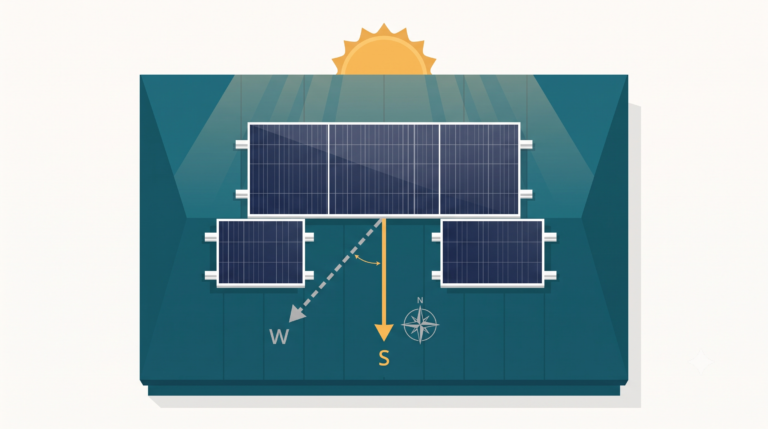
- Verify the direction. True south (or true north below the equator), corrected for magnetic declination. A perfect tilt facing the wrong way loses more than an imperfect tilt facing the right way.
Common Mistakes
Using someone else’s number. Solar forums are full of “just set it to 30°” advice. That’s correct in Houston and costs real money in Minneapolis. Latitude is personal.
Paying for precision that doesn’t pay back. Custom racking to move from 35° to 38° buys you about half a percent. Spend that money on one more panel instead.
Optimizing the angle and ignoring the shade. A tree shadow across one string at 2 PM costs far more than 10° of tilt error. Angle optimization comes after shade analysis, never instead of it.
Confusing magnetic south with true south. The compass error can exceed 15° in parts of the US — enough to quietly erase everything the perfect tilt angle gained you.
Treating the installer’s default as optimized. Standard racking comes in standard angles. Sometimes those match your latitude. Sometimes they match the installer’s warehouse inventory. Ask which.
Expert Tips
Think in bands, not points. Your production curve is nearly flat within ±5° of optimal. Choose the angle inside that band that’s cheapest to build and easiest to maintain.
Steeper beats flatter when in doubt. The self-cleaning effect (rain washing dust at 10°+), faster snow shedding, and better winter balance all favor erring a few degrees steep rather than a few degrees flat.
New construction is the free lunch. If you’re still designing the house, a south-facing roof pitched near your latitude turns the entire roof into optimal racking — at zero added cost. This decision is worth more than any panel brand comparison.
Revisit the number if your usage changes. Bought an EV that charges overnight? Added a heat pump? Your consumption pattern shifted, and for adjustable systems, your best angle may have shifted with it.
Conclusion: One Number, Then One Decision
The best angle for solar panels starts and ends with your latitude. The sun’s height in your sky is fixed by where you live, the panel tilts to meet it, and every refinement — cloud, snow, billing, hemisphere — is a small correction to that single anchor.
So: get your latitude, apply at most one adjustment, check it against your roof, and stop optimizing when you’re within five degrees. That’s the whole game.
Want to see exactly where these numbers come from — and be able to check them yourself with nothing but a calculator app? In the next guide, calculate your solar panel angle manually with these formulas, including the solar declination math your latitude rule quietly stands on.
The sun’s position is astronomy. Your panel’s position is a choice. Make it deliberately.
Frequently Asked Questions
What is the best angle for solar panels?
The best angle for solar panels approximately equals your latitude, with panels facing true south in the Northern Hemisphere. Most US homes perform best between 30° and 45°. Cloudy climates favor slightly flatter angles; snow country and off-grid systems favor slightly steeper ones.
What is the best angle for solar panels in the USA?
Between 25° and 48°, depending on your state’s latitude. Southern states like Florida and Texas optimize near 25–30°, mid-latitude states near 35–40°, and northern states like Washington and Minnesota near 45–48°.
Is a 30-degree angle good for solar panels?
Yes, if you live near 30°N latitude — roughly the line through Houston, New Orleans, and Jacksonville. Farther north, 30° leans summer-heavy and gives up winter production; a home at 42°N would leave several percent of annual output on the table.
Does the best angle change with the seasons?
Yes. The winter optimum is roughly your latitude plus 15°, and the summer optimum is your latitude minus 15°. Fixed systems use the year-round latitude angle as the compromise, capturing 96–98% of what seasonal adjustment would deliver.
What angle should solar panels be at 40 degrees latitude?
About 40° for a fixed year-round installation. If the system is adjustable, roughly 55° in winter and 25° in summer. Cities near this latitude include Denver, Philadelphia, and Columbus.
Why do cloudy places like the UK use a flatter angle than their latitude?
Because heavy cloud cover converts much of the sunlight into diffuse radiation scattered across the whole sky. Flatter panels see more sky and collect more of that scattered light, which is why UK optima sit around 35–42° despite latitudes above 50°N.
Should my solar panels match my roof angle?
If your roof pitch falls within 10–15° of your latitude-based target, yes — flush-mounting is cheaper, handles wind better, and the output difference is only a few percent. Beyond that gap, tilt racking starts to earn its cost, especially on flat roofs.
Is it better for solar panels to be too steep or too flat?
When forced to choose, lean steep. Steeper panels self-clean in rain, shed snow faster, and hold up winter production. Flat-biased errors compound: dirt accumulation plus weak winter output plus snow coverage.
What angle is best for solar panels in winter?
Your latitude plus about 15°. The winter sun sits low on the horizon, so panels stand steeper to face it directly. Steeper winter angles also shed snow much faster, protecting production on the clear cold days that follow storms.
Do solar panels need a different angle in the Southern Hemisphere?
The tilt math is identical — angle roughly equals latitude — but panels face true north instead of true south, and the seasonal calendar flips: steepest tilt in June, flattest in December.