
How to Calculate Solar Panel Angle Manually (Formulas + Examples)
Solar calculators are great. This site is built around one. But there’s a specific kind of confidence that comes from being able to check the machine’s answer with a pencil.
That’s what this guide delivers: the three formulas that determine solar panel angles — annual, seasonal, and monthly — with the actual astronomy behind them and worked examples you can follow line by line.
By the end, you’ll be able to calculate an angle for any address on Earth using nothing but latitude and basic arithmetic. No trigonometry degree needed. If you can subtract, you can do this.
And when an installer quotes you a number, you’ll know within thirty seconds whether it’s engineering or inventory.
Key Takeaways
- Annual formula: optimal tilt ≈ your latitude. A 40°N home tilts panels near 40°.
- Seasonal formulas: latitude + 15° for winter, latitude − 15° for summer, latitude for spring and fall.
- Monthly formula: tilt = latitude − solar declination, where declination is the sun’s seasonal offset (ranging from +23.45° in June to −23.45° in December).
- The declination cycle is why one fixed angle can never be perfect year-round — the target moves about 47° across the seasons.
- Refined empirical formulas exist (latitude × 0.9 variants), but they change the answer by only a few degrees, worth under 2% of annual output.
- Every formula here assumes clear-sky geometry. Heavy cloud, snow, and shading move the real-world optimum — covered at the end.
The Three Formulas at a Glance
Here’s the entire toolbox before we unpack it:
| Goal | Formula | Example at 40°N |
|---|---|---|
| Year-round fixed tilt | Tilt = latitude | 40° |
| Winter optimization | Tilt = latitude + 15° | 55° |
| Summer optimization | Tilt = latitude − 15° | 25° |
| Spring/fall | Tilt = latitude | 40° |
| Any specific month | Tilt = latitude − declination | varies (see table) |
Three inputs total: your latitude, the season or month you care about, and — for monthly precision — one number from a declination table. That’s the whole game.
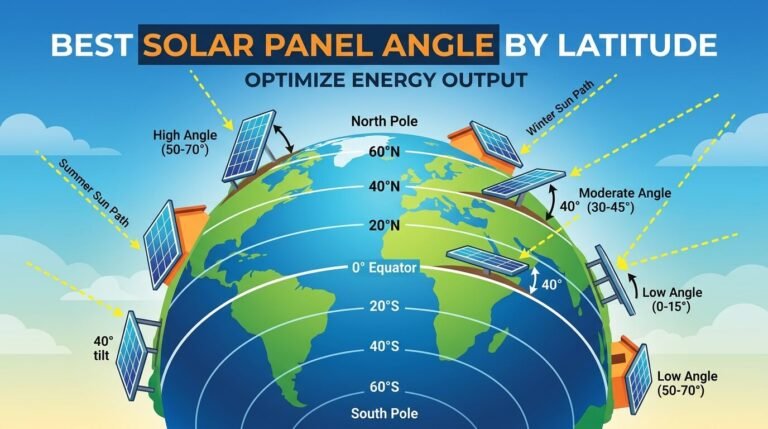
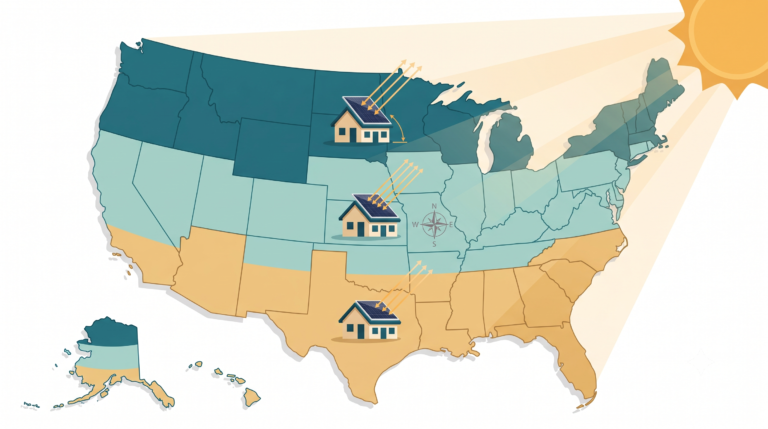
If you haven’t read why latitude sets the best solar panel angle, the one-line recap: your latitude equals the sun’s average distance from directly overhead at your location, so the panel tilts by that same amount to face it squarely. Every formula below is a variation on that idea.
Formula 1: The Annual Angle
Optimal year-round tilt = your latitude
That’s it. Find your latitude on any map app and you have your baseline.
Worked Example: Denver, Colorado
- Denver’s latitude: 39.7°N
- Annual tilt = 39.7°
- Round to 40°. Done.
Rounding is fine — genuinely fine. Panel output falls along a cosine curve near the optimum, which means the first few degrees of error cost almost nothing. Five degrees off is roughly a 1% loss. Chasing decimals here is effort without payoff.
The Refined Variants (And Why They Barely Matter)
Empirical studies that fit tilt angles against decades of measured irradiance data produce slightly flatter recommendations:
- Tilt = latitude × 0.9 → 35.7° for Denver
- Tilt = latitude − 2.5° → 37.2° for Denver
Why flatter? Two reasons. Summer days are longer, so there are more summer photons to collect, and a flatter panel favors them. And some light arrives diffusely from the whole sky rather than the sun’s disk — flatter panels see more sky.
The spread between all three answers is under 5°, worth around 1% of production. Use whichever you like. The variable that actually matters is the one they all share: latitude.
Formula 2: The Seasonal Angles
Winter tilt = latitude + 15° Summer tilt = latitude − 15° Spring/fall tilt = latitude
The logic: the noon sun rides roughly 23.45° higher than its average in midsummer and 23.45° lower in midwinter — Earth’s axial tilt at work. The ±15° adjustment is a season-wide compromise across each three-month window rather than a single-day bullseye, which is why it’s smaller than the full ±23.45° swing.
Worked Example: Denver Again
- Latitude: 39.7°
- Winter: 39.7 + 15 = 54.7° → 55°
- Summer: 39.7 − 15 = 24.7° → 25°
- Spring/fall: 40°
A Denver ground-mount owner adjusting four times a year would cycle 40° → 25° → 40° → 55° through the seasons.
The Sharper Empirical Version
Optimization work against measured US irradiance data produced a widely cited refined pair:
- Winter: latitude × 0.9 + 29° → 64.7° for Denver
- Summer: latitude × 0.9 − 23.5° → 12.2° for Denver
Notice these push harder than the ±15° rule — steeper in winter, flatter in summer. That’s because they optimize for the solstice-centered window where the sun lingers near its extreme, rather than averaging across the whole season. If you adjust only twice a year and want maximum aggression, these are your numbers. If you’d rather keep it simple, ±15° captures most of the benefit.
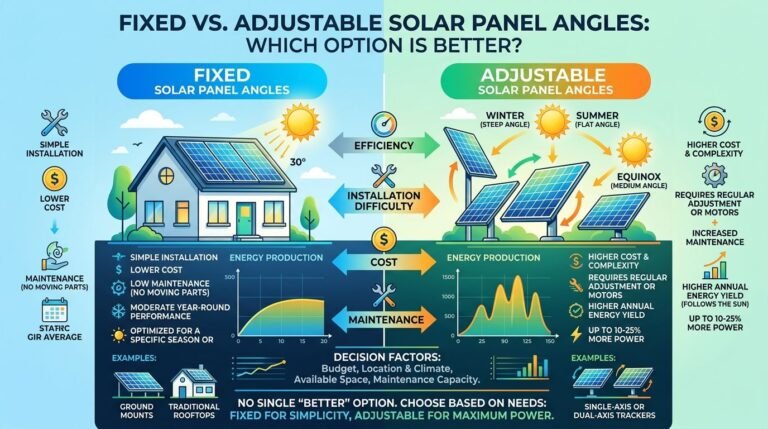
Either way, the payoff ceiling is modest: twice-yearly adjustment adds roughly 4–5% of annual output over a fixed mount. Worth fifteen minutes for a ground mount at arm’s reach. Rarely worth a ladder.
Formula 3: The Monthly Angle (Where the Real Astronomy Lives)
Monthly tilt = latitude − solar declination
This is the formula professional tools actually run, and it requires understanding one concept: solar declination.
What Solar Declination Is
Declination (symbol: δ) is the angle between the sun’s rays and Earth’s equatorial plane on a given day. Because Earth’s axis tilts 23.45°, declination cycles through the year:
- +23.45° at the June solstice (sun directly over the Tropic of Cancer)
- 0° at the March and September equinoxes (sun over the equator)
- −23.45° at the December solstice (sun over the Tropic of Capricorn)
When declination is positive, the sun sits higher in Northern Hemisphere skies, so you subtract more and tilt flatter. When it’s negative, the sun sits lower, the subtraction adds, and you tilt steeper. One formula, twelve answers.
The Declination Table (Mid-Month Values)
| Month | Declination (δ) | Month | Declination (δ) |
|---|---|---|---|
| January | −20.9° | July | +21.2° |
| February | −13.0° | August | +13.5° |
| March | −2.4° | September | +2.2° |
| April | +9.4° | October | −9.6° |
| May | +18.8° | November | −18.9° |
| June | +23.1° | December | −23.0° |
Calculating Declination From Scratch (Optional Credit)
The table above comes from Cooper’s equation, a standard approximation in solar engineering:
δ = 23.45° × sin[(360/365) × (284 + n)]
where n is the day of the year (January 1 = 1). For June 21 (n = 172), the formula returns +23.4° — the summer solstice, exactly as expected. You’ll never need to run this by hand, but knowing it exists means the table is checkable, not magic.
Worked Example: Denver, Month by Month
Tilt = 39.7° − δ:
- December: 39.7 − (−23.0) = 62.7° → 63°
- March: 39.7 − (−2.4) = 42.1° → 42°
- June: 39.7 − 23.1 = 16.6° → 17°
- September: 39.7 − 2.2 = 37.5° → 38°
Look at that December number: 63°, far steeper than the ±15° seasonal rule suggested. Monthly math doesn’t compromise — it aims at each month’s actual sun. The cost is eleven adjustment sessions a year for a gain of only 5–7% over a fixed mount, which is why monthly tracking makes sense almost exclusively for RV owners and off-grid arrays at ground level.
The Formula Behind the Formulas: Noon Sun Altitude
Everything above compresses into one line of astronomy worth knowing:
Noon sun altitude = 90° − latitude + declination
Run Denver in December: 90 − 39.7 + (−23.0) = 27.3°. The noon sun barely clears a quarter of the sky. And the perpendicular-facing panel tilt? 90 − 27.3 = 62.7° — precisely the December answer from Formula 3.
Latitude rule, seasonal offsets, monthly declination math: all of them are this single equation wearing different amounts of simplification. If you remember one thing from this article, make it this line.
Bonus Conversions You’ll Actually Use
Roof Pitch to Degrees
Roofers speak in rise-over-run. Convert with:
Angle = arctan(rise ÷ run)
A 6/12 pitch: arctan(6 ÷ 12) = arctan(0.5) = 26.6°. Any phone calculator with a tan⁻¹ button does this in five seconds. Common values: 4/12 = 18.4°, 8/12 = 33.7°, 12/12 = 45°.
Southern Hemisphere
Identical math with two flips: use the absolute value of your latitude, and add the declination instead of subtracting (or equivalently, flip the declination’s sign). Sydney at 33.9°S in June: 33.9 + 23.1 = 57° — midwinter steep, facing true north.
Near the Equator
Below about 10° latitude, monthly math sometimes returns a negative tilt. That’s not an error — it means the sun has crossed to the other side of the sky, and the “correct” panel briefly faces the opposite direction. Practical answer: mount nearly flat (but at least 10° for rain self-cleaning) and accept a trivially small loss.
Step-by-Step: Your Complete Manual Calculation
- Find your latitude. Map app, two taps, one decimal place.
- Annual angle: write down your latitude. That’s the number.
- Seasonal angles: add 15° for winter, subtract 15° for summer.
- Monthly angles (optional): pull each month’s declination from the table and compute latitude − δ.
- Sanity-check against your roof: convert your pitch with arctan(rise ÷ run). Within 10–15° of your annual angle? Flush-mount and keep the racking money.
- Verify with a tool. Manual math builds understanding; cross-checking catches slips. You can skip the math with our tilt angle calculator — enter your coordinates and compare its annual, seasonal, and monthly output against your worksheet. Matching numbers mean you did it right. A mismatch usually means a sign error on declination.
Common Calculation Mistakes
Flipping the declination sign. The classic. Winter declination is negative, and subtracting a negative makes your tilt steeper. If your December angle came out flatter than your June angle, you inverted the sign.
Using longitude instead of latitude. Coordinates come in pairs, and grabbing the wrong one produces confidently absurd answers. Latitude is the north–south number, between 0 and 90.
Applying Northern formulas below the equator. Sydney is not 33.9° of winter tilt in December — December is Sydney’s summer. Flip the calendar with the hemisphere.
Treating the formula output as gospel in cloudy climates. Clear-sky geometry says London wants 51°. Decades of satellite irradiance data say 35–42°, because diffuse light rewards flatter panels. Formulas give the baseline; climate adjusts it.
Measuring roof pitch in degrees when it was quoted in rise/run. A “6 pitch” roof is 26.6°, not 6°. That mix-up produces a 20° error — real money.
Expert Tips
Do the math once, on paper, before any installer visit. Not because you’ll out-engineer them, but because the conversation changes when you ask “why 30° instead of my latitude?” and watch how they answer. Inventory-driven proposals reveal themselves fast.
Round to the nearest 5°. Racking hardware typically adjusts in coarse increments anyway, and the cosine curve forgives. Precision theater wastes attention that shade analysis deserves.
Keep the declination table with your system documents. If you ever add adjustable ground-mount capacity, the twelve-month schedule is already computed.
Winter-weight if you’re off-grid. The formulas optimize energy, not usefulness. When December production must cover December consumption, bias toward the winter number rather than the annual one — surplus you can’t store in July is worth nothing in January.
Best Practices for Reliable Results
Write the units next to every number. Half of all manual-calculation errors trace back to a bare “6” that was a pitch, a declination, or a rounding note ten minutes earlier. Label as you go and the sign mistakes surface immediately.
Calculate twice, from two directions. Run the seasonal shortcut (latitude ± 15°) and the monthly formula for the same season. If December’s monthly answer isn’t steeper than the winter shortcut, something flipped — usually the declination sign.
Anchor everything to the noon-altitude equation. When any result feels off, compute 90° − latitude + declination and ask whether that sun height makes sense for the month. A 70° noon sun in a Minnesota December fails the smell test instantly.
Date your worksheet and keep it. Panel positions get revisited — after re-roofing, after adding capacity, after an EV changes your usage curve. A saved calculation with your assumptions written down turns a future afternoon of rework into a five-minute review.
Conclusion: Astronomy You Can Do on a Napkin
Three formulas, one underlying equation, and a declination table — that’s the complete manual toolkit for solar panel angles. Your latitude anchors everything. The seasons swing ±23.45° around it. And every calculator on the internet, including ours, is running some dressed-up version of the same arithmetic you just did by hand.
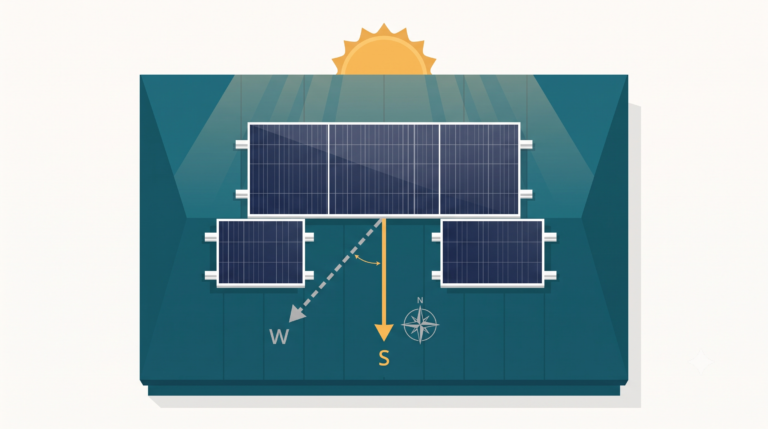
But tilt is only half of panel positioning. The other half is which way the panels face — and it hides a trap that costs some homeowners more output than any tilt error: the difference between what your compass reads and where south actually is. Next in this series, point your panels in the right solar panel direction, including the two-minute fix for magnetic declination.
The math is done. Now aim it.
Frequently Asked Questions
How do you calculate the angle for solar panels?
Set the tilt equal to your latitude for year-round performance. For seasonal tuning, add 15° in winter and subtract 15° in summer. For monthly precision, use tilt = latitude − solar declination, pulling each month’s declination from a standard table.
What is the formula for solar panel tilt angle?
The base formula is tilt = latitude. The month-specific version is tilt = latitude − δ, where δ is the solar declination for that date, ranging from +23.45° at the June solstice to −23.45° at the December solstice.
What is solar declination?
Solar declination is the angle between the sun’s rays and Earth’s equatorial plane on a given day. It cycles between +23.45° and −23.45° through the year because of Earth’s axial tilt, and it’s the reason optimal panel angles change with the seasons.
How do I calculate solar panel angle for winter?
Add 15° to your latitude for a season-wide setting, or use latitude minus December’s declination (−23°) for solstice-centered precision. A 40°N home gets 55° by the simple rule or 63° by the monthly formula.
How do I convert roof pitch to degrees?
Use angle = arctan(rise ÷ run). A 6/12 pitch converts as arctan(0.5) = 26.6°. Common results: 4/12 = 18.4°, 8/12 = 33.7°, and 12/12 = 45°.
Is the calculation different in the Southern Hemisphere?
The math is the same with two flips: use the absolute value of your latitude, add the declination instead of subtracting it, and face panels true north. The seasonal calendar also inverts — steepest tilt in June, flattest in December.
How accurate are the manual formulas?
Within a few degrees of professional software for clear-sky conditions, which translates to roughly 1–2% of output. The bigger real-world gaps come from climate factors the formulas ignore: heavy cloud cover favors flatter angles, and snow country favors steeper ones.
What does a negative tilt angle mean?
It appears in tropical latitudes when the sun crosses to the opposite side of the sky for part of the year. It means the panel would ideally face the other direction those months. In practice, tropical installs mount nearly flat and accept a negligible loss.
How much does monthly adjustment gain over a fixed angle?
About 5–7% of annual output, versus 4–5% for twice-yearly adjustment and 96–98% capture for a well-set fixed mount. Monthly changes only make sense for ground-level arrays you can reach without a ladder.
What is the sun’s noon altitude formula?
Noon altitude = 90° − latitude + declination. It gives the sun’s height above the horizon at solar noon for any date, and every panel-angle formula is a simplification of it — the perpendicular tilt is simply 90° minus that altitude.