What Is Solar Panel Tilt Angle? A Beginner’s Guide to Panel Positioning
Here’s a number most solar owners never hear: the gap between a flat panel and a properly positioned one runs 10–25% of total output. Same panels. Same roof. Same sun. The only difference is a single setting most people never check.
That setting is the tilt angle.
If you’re planning a solar install, shopping for quotes, or trying to figure out why your existing system produces less than the brochure promised, this guide covers the one variable that costs nothing to get right and pays you back for 25+ years.
No engineering degree required. Just a protractor’s worth of geometry and about eight minutes of reading.
Key Takeaways
- Solar panel tilt angle is the angle between your panel’s surface and the ground — 0° is flat, 90° is vertical.
- Panels produce maximum power when sunlight strikes the glass at exactly 90°. Every degree of deviation wastes a slice of every ray.
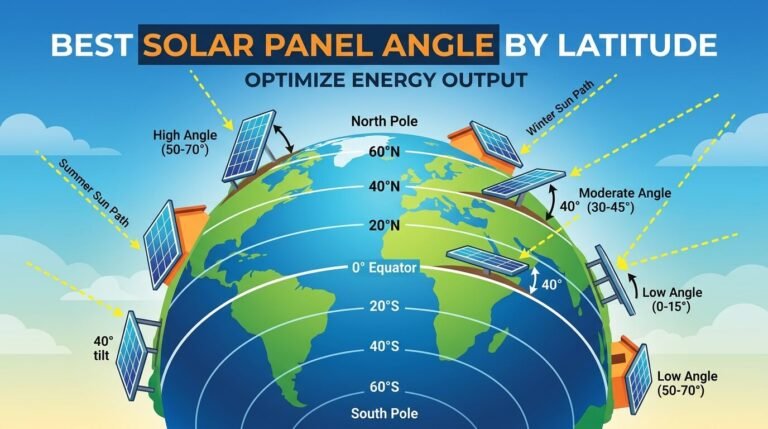
- Your latitude sets your baseline angle. A home at 40°N generally performs best near 40° of tilt.
- Tilt and direction (azimuth) are two different settings. Both must be right; neither can compensate for the other.
- The sun’s height changes roughly 47° between June and December, which is why winter and summer have different ideal angles.
- Getting within 5° of your target costs you about 1% of output — precision matters, but perfection doesn’t.
What Is Solar Panel Tilt Angle?
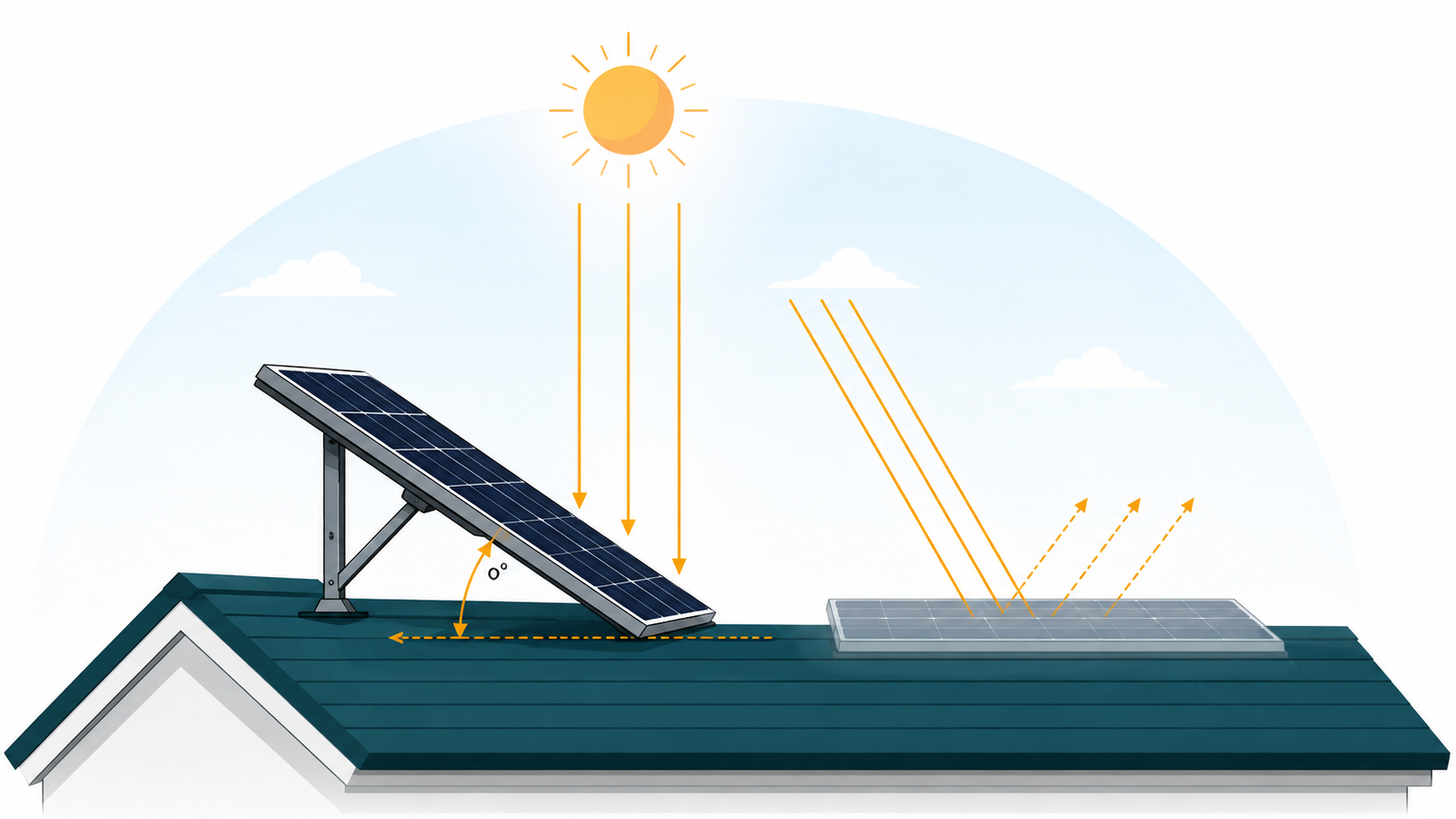
Solar panel tilt angle is the angle formed between the surface of a solar panel and the horizontal ground beneath it. A panel lying completely flat has a tilt of 0°. A panel standing straight up against a wall has a tilt of 90°. The ideal setting falls somewhere between the two and depends primarily on your latitude.
That’s the textbook definition. Here’s the version that matters for your electric bill.
A solar panel is a light collector. It converts photons into electrons, and it does that job best when light hits the glass dead-on — at a perfect right angle to the surface. Physicists call this the angle of incidence, and when it’s 0° (light perpendicular to the panel), you get the panel’s full rated output.
Tilt the light away from perpendicular and output drops. Not because the panel is broken. Because geometry says a slanted surface intercepts fewer photons per square foot. The steeper the slant, the bigger the loss.
Your tilt angle is how you aim the collector at the source.
The Simple Mental Model
Picture holding a book up to a reading lamp.
Hold the cover flat toward the bulb and the whole page glows evenly. Now rotate the book 45°. Half the light skims across the surface instead of landing on it. Rotate further and the page goes dim.
Your solar array is the book. The sun is the lamp. Tilt angle is your wrist.
The complication — and the reason this topic fills an entire guide instead of one sentence — is that the lamp moves. Every hour of the day and every week of the year, the sun sits at a different height in your sky. Panel positioning is the art of choosing one wrist position that works best across all of them.
Tilt Angle vs. Azimuth: Two Settings, Not One
Beginners mix these up constantly, and the confusion costs real money. Your panels have two positioning controls:
Tilt (elevation angle): how far the panel leans back from vertical. Measured in degrees from horizontal. This is the up-and-down setting.
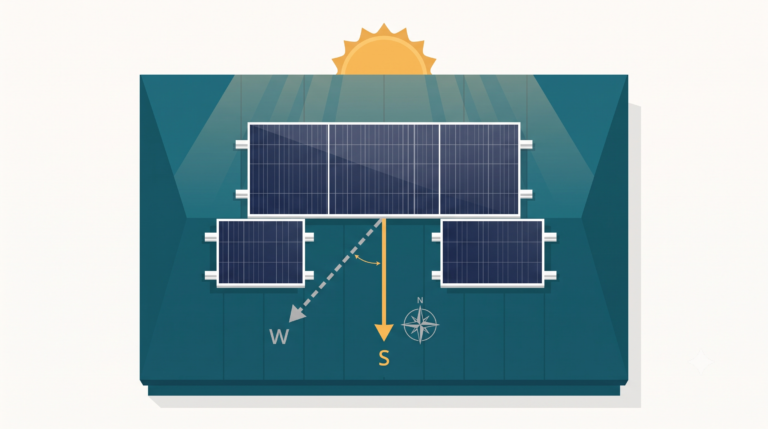
Azimuth (direction): which way the panel faces on a compass. In the Northern Hemisphere, that target is true south. Below the equator, true north. This is the left-and-right setting.
Think of aiming a satellite dish. Point it at the right spot on the horizon but angle it into the dirt, and you get nothing. Angle it perfectly but face it the wrong direction, and you also get nothing. Both settings have to land.
One trap worth flagging early: your phone’s compass points to magnetic south, not true south, and the difference between them can exceed 15° depending on where you live. Aim your array by compass in a high-declination region like the Pacific Northwest and you’ll quietly bleed output for decades without knowing why. NOAA publishes declination values for every location in the US, and correcting your reading takes two minutes.
This guide focuses on tilt. Just remember it’s half of a two-part answer.
Why Tilt Angle Changes Your Output So Much
Three forces stack together to make tilt one of the highest-leverage decisions in any solar install.
1. The Cosine Effect
Light arriving at an angle spreads across more surface area, which dilutes its intensity. The math follows a cosine curve, and the practical takeaway is this: small errors are cheap, large errors are brutal.
| Deviation From Perpendicular | Approximate Output Retained |
|---|---|
| 0° (dead-on) | 100% |
| 10° | ~98% |
| 25° | ~91% |
| 45° | ~71% |
| 60° | ~50% |
Notice the shape of that table. Being 10° off costs almost nothing. Being 45° off costs nearly a third of your production. This is why a completely flat panel in a northern state underperforms so badly in winter — the low sun can arrive 60°+ away from perpendicular.
2. The Sun’s Height Depends on Your Latitude
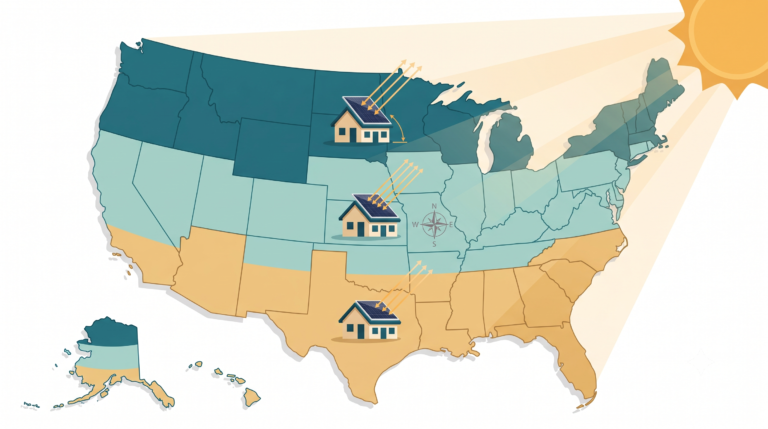
At the equator, the midday sun passes almost directly overhead, so panels lie nearly flat. In Anchorage, the sun never climbs that high, so panels stand steep to face it.
Latitude is a permanent fact about your address. It fixes the sun’s average path across your sky, which is why nearly every tilt formula starts with it. As a rough rule, your baseline tilt roughly equals your latitude — a starting point we unpack fully in the next article of this series.
3. The Seasons Move the Target
Earth’s axis is tilted 23.45°, so the sun’s noon height at your location swings roughly 47° between the summer and winter solstices. In June the sun rides high and a flatter panel catches it. In December it hugs the horizon and a steeper panel meets it.
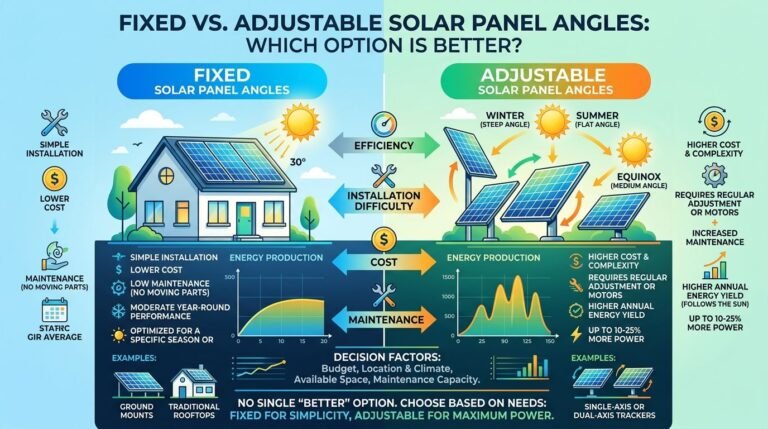
One angle can’t be perfect for both. That’s why fixed installs use a year-round compromise, while adjustable and ground-mounted systems change angle by season.
How Tilt Angle Is Measured (And How to Measure Yours)
The measurement itself is simple: degrees above horizontal.
- 0° — panel lying flat, glass facing straight up
- 30° — a typical residential roof slope
- 90° — panel mounted vertically, like on a wall or balcony railing
Reading Your Roof’s Existing Angle
Most rooftop systems mount flush to the roof, which means your roof pitch is your tilt angle. Roofers describe pitch as rise over run — “6/12” means the roof rises 6 inches for every 12 horizontal inches. Converting to degrees:
| Roof Pitch | Tilt Angle |
|---|---|
| 3/12 | 14.0° |
| 4/12 | 18.4° |
| 5/12 | 22.6° |
| 6/12 | 26.6° |
| 8/12 | 33.7° |
| 10/12 | 39.8° |
| 12/12 | 45.0° |
Three Ways to Measure Tilt Yourself
- Phone inclinometer. Every modern smartphone has a level/measure app. Lay the phone flat against the panel or roof surface and read the angle directly. Accurate to within a degree or two, which is plenty.
- The rafter method. In your attic, measure 12 inches horizontally along a level from a rafter, then measure straight down to the rafter. That vertical distance is your rise — 8 inches means an 8/12 pitch, or 33.7°.
- Count from the ground. Take a side-on photo of your house, open it in any image editor with an angle tool, and measure the roof line against horizontal. Crude but surprisingly usable for planning.
What Happens at Different Tilt Angles
Understanding the trade-offs at each range helps you recognize what your own setup is doing well — and where it’s leaking.
Flat or Near-Flat (0–10°)
Strong in summer when the sun is high. Weak in winter. And there’s a maintenance problem almost nobody mentions in sales conversations: below roughly 10°, rain can’t properly wash dust and pollen off the glass. Grime pools, builds a film, and shaves output until someone climbs up with a squeegee. Installers keep tilt above 10° largely for this self-cleaning effect.
Moderate (25–40°)
The sweet spot for most of the continental United States, which spans roughly 25°N to 49°N latitude. If your roof pitch lands here, you’ve essentially won the positioning lottery — flush mounting works, no angled racking needed.
Steep (45–60°)
Ideal for high-latitude locations, winter-heavy energy needs, and off-grid homes that live or die by December production. Steep angles also shed snow dramatically faster, which matters more than most output charts capture — a snow-covered panel produces zero regardless of its theoretical angle.
Vertical (90°)
Balcony solar, wall mounts, and solar fences. Vertical panels sacrifice summer production but perform surprisingly well in winter at high latitudes, and they never hold snow. A niche choice, but a growing one in dense housing.
Fixed vs. Adjustable: A Preview
Your tilt strategy branches into two paths:
Fixed tilt locks in one compromise angle year-round. It captures roughly 96–98% of what seasonal adjustment would deliver, requires zero maintenance visits, and is the right call for almost every rooftop system.
Adjustable tilt lets you steepen the array in fall and flatten it in spring. Twice-yearly changes add about 4–5% annual output — meaningful for ground mounts and RV arrays you can reach without a ladder, rarely worth the roof risk otherwise.
We compare the economics in detail later in this series. For now, the beginner takeaway: don’t let anyone sell you adjustable rooftop racking on output promises alone. Run the percentages first.
Common Beginner Mistakes
Mistake 1: Treating tilt as the installer’s problem. Installers optimize for install speed and standard racking as often as for your production. Walk into the quote conversation already knowing your number, and you change the entire dynamic.
Mistake 2: Copying a neighbor’s setup. Their roof direction, shading pattern, and energy usage are not yours. Two houses on the same street can genuinely need different configurations.
Mistake 3: Chasing the perfect degree. The cosine table above shows why: 5° of error costs about 1%. Paying for custom racking to fix a rounding error is money down the drain. Get close; don’t get obsessive.
Mistake 4: Optimizing for the wrong season. Grid-tied homes with net metering usually want maximum annual production. But off-grid cabins and heat-pump households need power most in the darkest months — exactly when a summer-biased flat angle collapses. Match the angle to when you need energy.
Mistake 5: Ignoring the direction half of the equation. A perfect tilt facing the wrong way loses more than a mediocre tilt facing the right way. Fix both.
Best Practices for Getting Started
- Find your latitude first. It’s the anchor for every calculation that follows. Any map app shows it in two taps.
- Measure your actual roof pitch using one of the three methods above. Compare it against your latitude. Within 10–15°? Flush-mount and move on.
- Verify true south, not magnetic south, using NOAA’s declination data or the solar-noon shadow trick: at solar noon, the shadow of a vertical pole points exactly along the true north–south line.
- Run your exact coordinates through a proper tool. A free solar panel tilt angle calculator will return your annual, seasonal, and monthly angles in seconds — including the correct facing for your hemisphere — so you can check any installer’s proposal against real numbers.
- Document your baseline. Whatever angle you end up with, write it down along with your system’s first-month production. Future troubleshooting starts with knowing what “normal” looked like.
Expert Tips Most Guides Skip
Cloudy climates bend the rules. In regions with heavy cloud cover — the UK, the Pacific Northwest — a meaningful share of your light arrives as diffuse radiation scattered across the whole sky rather than direct beams from the sun’s position. Diffuse light favors slightly flatter angles than the raw latitude rule suggests. The European Commission’s PVGIS database confirms this offset for northern Europe.
Temperature quietly rewards steeper angles in some climates. Solar panels lose efficiency as they heat up — typically 0.3–0.4% per °C above 25°C. Steeper mounting improves airflow behind the panel and can slightly offset summer heat losses. It’s a minor effect, but it’s one more reason not to fear an angle a few degrees steeper than “optimal.”
Snow changes the calculus entirely. In snow country, a panel at 45° that sheds snow by noon outproduces a “perfectly optimized” 38° panel that stays buried for three days. Published output tables assume clean glass; your winters may not cooperate.
Vertical bifacial panels are rewriting some assumptions. Ground-mounted vertical east-west bifacial arrays produce two daily peaks (morning and evening) that match household usage curves better than a single noon spike. Beginner installs shouldn’t start here, but it’s worth knowing the field is moving.
Conclusion: One Setting, 25 Years of Returns
Solar panel tilt angle is the angle between your panels and the ground — and it’s the cheapest performance upgrade in all of solar. No new hardware. No permits. Just geometry, applied once, compounding for the life of the system.
You now know what tilt is, how it differs from direction, why the cosine effect punishes big errors and forgives small ones, and how to measure what you’re working with.
The next question is the obvious one: what should your number actually be? The answer starts with a single figure you already have — your latitude. In the next guide, discover the best angle for solar panels at your latitude, including the formulas, the exceptions, and the regions where the standard rule quietly fails.
Your panels are going to sit at some angle for the next 25 years. Make it a chosen one.
Frequently Asked Questions
What is the tilt angle of a solar panel?
Tilt angle is the angle between a solar panel’s surface and the horizontal ground, measured in degrees. A flat panel sits at 0°, a vertical panel at 90°, and the ideal setting for most homes falls between 25° and 45°, depending on latitude.
Is tilt angle the same as roof pitch?
For flush-mounted rooftop systems, yes — your roof pitch becomes your panel tilt. A 6/12 pitch roof gives panels a 26.6° tilt. Ground mounts and angled racking let you choose a tilt independent of any roof.
Does solar panel tilt angle really matter?
Yes. The difference between a flat panel and a properly tilted one runs 10–25% of annual output depending on latitude. On a 10 kW system, that’s the production of one to two entire panels, every year, for the system’s life.
What happens if my solar panels are completely flat?
They still produce power, but you lose significant winter output, and rain can no longer wash dust off the glass — grime buildup steadily cuts production. If flat mounting is unavoidable, budget for periodic cleaning.
What is the angle of incidence in solar?
The angle of incidence is the angle between incoming sunlight and a line perpendicular to the panel surface. At 0° (light hitting dead-on), the panel produces full rated output. Output falls along a cosine curve as the angle grows.
How do I measure my roof’s tilt angle?
Use a phone inclinometer app laid flat against the roof surface, or measure rise-over-run from your attic: 12 inches horizontal, then the vertical drop to the rafter. An 8-inch drop equals an 8/12 pitch, or about 33.7°.
Is a steeper or flatter solar panel angle better?
Neither is universally better. Steeper angles win in winter, at high latitudes, and in snow country. Flatter angles win in summer and near the equator. Your latitude and your seasonal energy needs decide which way to lean.
How accurate does my tilt angle need to be?
Within about 5° of your target costs you only around 1% of output. Precision beyond that delivers almost nothing, so don’t pay for custom hardware to fix a few degrees.
Do vertical solar panels work?
Yes, especially at high latitudes and on balconies. Vertical panels give up summer production but perform respectably in winter, never accumulate snow, and vertical bifacial arrays can match household usage curves well.
What’s the difference between tilt and azimuth?
Tilt is the up-and-down lean of the panel, measured from horizontal. Azimuth is the compass direction the panel faces — true south in the Northern Hemisphere, true north in the Southern. Both must be correct for full output.