Solar Panel Direction: True South vs. Magnetic South Explained
Here’s an uncomfortable fact about American solar installations: some of them are aimed at the wrong “south.”
Not dramatically wrong. Not visibly wrong. Wrong by the width of a compass error — up to 15 degrees or more in parts of the country — because the person doing the aiming trusted a magnetic needle, and magnetic needles don’t point where most people think they point.
The result is a system that looks perfect, passes inspection, and quietly underdelivers for 25 years. No alarm ever goes off. The electricity that never got generated doesn’t leave a receipt.
This guide fixes that. You’ll learn what solar panel direction actually means, why true south and magnetic south are different targets, how much misalignment costs, and four reliable ways to find true south — two of which require nothing but a sunny day.
Key Takeaways
- Solar panels in the Northern Hemisphere should face true south (the direction of the geographic South Pole line), not the south your compass shows.
- A compass points to magnetic poles, which sit hundreds of miles from the geographic ones. The gap at your location is called magnetic declination, and in the continental US it ranges from about 15°E to 15°W.
- Aiming by uncorrected compass in a high-declination region can cost several percent of annual production — permanently.
- The fix takes two minutes: look up your declination and adjust your bearing, or use the solar-noon shadow method and skip the compass entirely.
- Direction (azimuth) and tilt are separate settings. Both must be right; neither compensates for the other.
- Perfect south isn’t always mandatory — southeast and southwest typically lose only 3–8%, and time-of-use billing can even reward a westward lean.
The Quick Answer
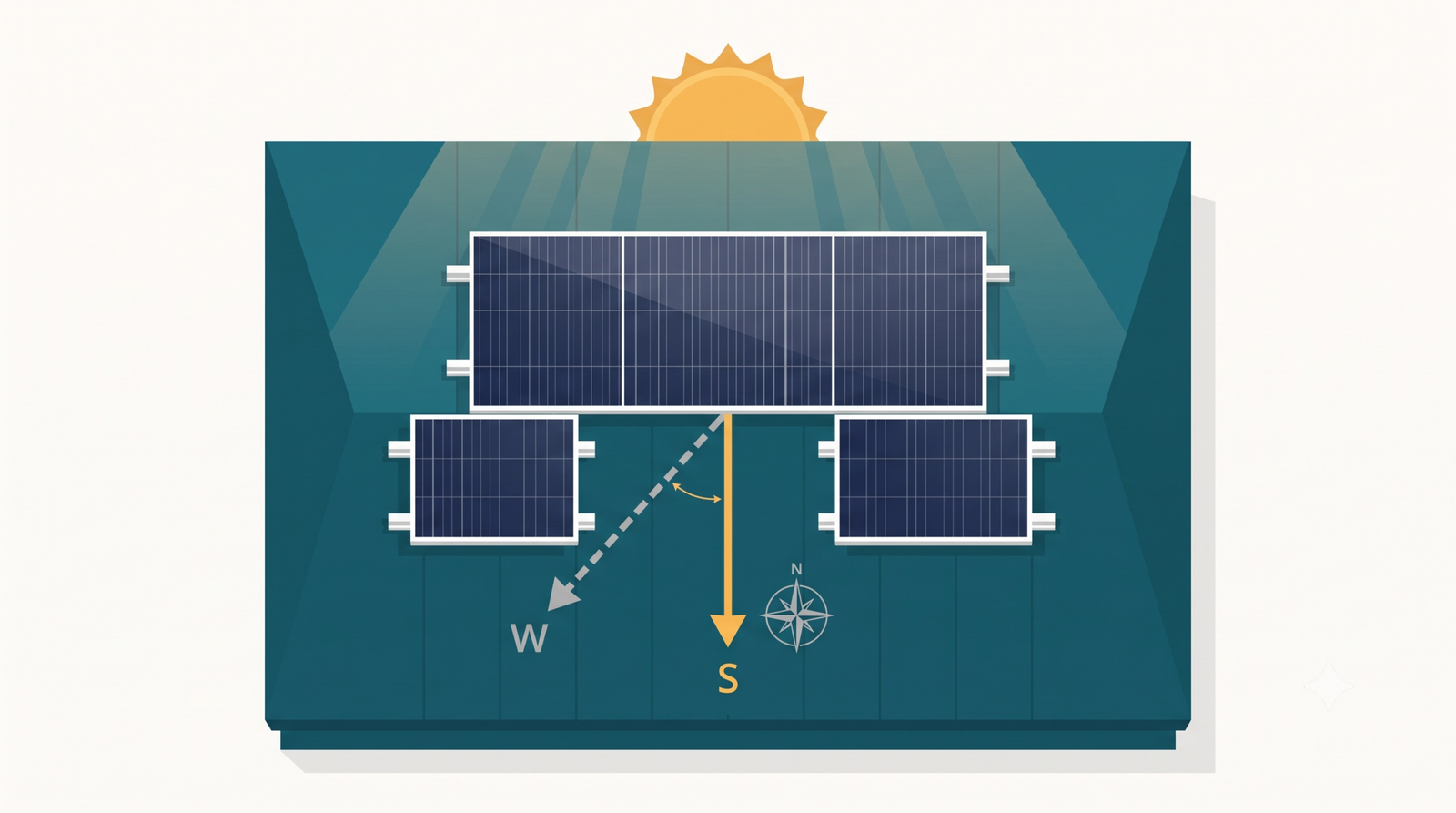
Solar panels should face true south in the Northern Hemisphere and true north in the Southern Hemisphere, because that’s the direction of the sun’s daily arc at its highest and strongest. True south differs from compass (magnetic) south by your local magnetic declination — up to 15° or more in parts of the US — so compass readings must be corrected before aiming an array.
That paragraph is the whole article in miniature. The rest is the why, the how much, and the how to fix it.
What “Direction” Means in Solar: Azimuth 101
Panel positioning has two controls. Tilt is the up-and-down lean — if you want that half of the story, start with our manual solar panel angle calculation guide. Direction is the left-and-right aim, and the industry measures it as azimuth: degrees clockwise from north.
- 0° = north
- 90° = east
- 180° = south ← the Northern Hemisphere target
- 270° = west
When a solar designer says “azimuth 180,” they mean the array faces due south — true south. And that qualifier is where homeowners get burned.
True South vs. Magnetic South: Two Different Places
True South
True south is a line of geography. Stand anywhere in the Northern Hemisphere, face the point on the horizon directly toward the geographic South Pole, and you’re facing true south. The sun crosses this line at its daily peak — solar noon — every single day of the year. That’s why it’s the target: it’s the center of the sun’s arc.
Magnetic South
Magnetic south is a line of physics. A compass needle aligns with Earth’s magnetic field, which converges not at the geographic poles but at the magnetic poles — and those wander. The north magnetic pole has drifted hundreds of miles across the Arctic in recent decades, moving from Canadian territory toward Siberia at tens of kilometers per year.
Your compass faithfully reports this moving magnetic geometry. It has no idea where the geographic pole is.
The Gap: Magnetic Declination
The angle between true north and magnetic north at your location is called magnetic declination, and it’s the exact error baked into every uncorrected compass reading.
Declination varies by where you stand. Across the continental US, it currently spans roughly:
| City | Approximate Declination |
|---|---|
| Seattle, WA | ~15°E |
| Los Angeles, CA | ~11°E |
| Phoenix, AZ | ~10°E |
| Denver, CO | ~8°E |
| Dallas, TX | ~3°E |
| Chicago, IL | ~4°W |
| Atlanta, GA | ~6°W |
| Miami, FL | ~7°W |
| New York, NY | ~12°W |
| Boston, MA | ~14°W |
(Values are approximate and drift a fraction of a degree per year as the magnetic pole moves — always pull a current figure from NOAA’s declination calculator before aiming hardware.)
Running roughly through the middle of the country is the agonic line — the zero-declination line where compass south and true south happen to agree. Live near it and your compass is accidentally honest. Live in Seattle or Boston and it’s off by the width of a clock’s hour marker.
What Misalignment Actually Costs
The sun forgives small aiming errors, then punishes larger ones on an accelerating curve:
| Facing (vs. true south) | Typical Annual Loss |
|---|---|
| Dead-on true south | 0% (baseline) |
| 10–15° off | ~1–3% |
| Southeast or southwest (45° off) | ~3–8% |
| Due east or due west (90° off) | ~15–20% |
| North-facing | 30%+ — avoid |
Two honest readings of that table.
First: a raw compass error of 10–15° costs “only” 1–3%. On a 10 kW system producing 13,000 kWh a year, 2% is roughly 260 kWh annually — a few thousand kWh over the system’s life, lost to an error that takes two minutes to prevent. Small percentage. Real electricity. Zero excuse.
Second: the table also liberates you. If your roof faces southeast, you are not doomed — you’re down single digits, and no amount of exotic racking is worth chasing that gap on a pitched roof. Precision matters most when you control the aim: ground mounts, flat-roof racking, and adjustable arrays.
Four Reliable Ways to Find True South
Method 1: Corrected Compass (2 minutes)
- Look up your current declination on NOAA’s magnetic declination calculator.
- Apply the rule: to face true south, aim at a magnetic bearing of 180° minus easterly declination, or 180° plus westerly declination.
- Seattle (15°E): aim at magnetic 165°. New York (12°W): aim at magnetic 192°.
One warning about phone compasses: they’re vulnerable to interference from metal roofing, gutters, HVAC units, and even the phone case’s magnets. Calibrate first, take readings away from metal, and treat the result as a starting estimate.
Method 2: The Solar-Noon Shadow (Zero equipment, maximum trust)
The sun crosses true south at solar noon — which is rarely 12:00 on your clock, thanks to time zones and daylight saving.
- Find today’s solar noon for your location (NOAA’s solar calculator lists it).
- A few minutes before, stand a straight vertical object — a broom handle, a fence post level — on flat ground.
- At solar noon exactly, mark the shadow line.
That shadow points true north, which makes the line under your feet a perfect true north–south axis. No magnetism involved, no correction needed, accurate to a fraction of a degree. This is the method surveyors’ instincts approve of.
Method 3: Satellite View
Online map tools align their imagery to true north by convention. Pull up your roof in satellite view, note how your ridgeline angles against the screen’s vertical, and you’ve measured your roof’s true orientation from a chair. Cross-check against Method 1 or 2 before committing hardware — imagery alignment is good, but trust deserves verification.
Method 4: The North Star
Polaris sits within about 1° of true celestial north. Face it on a clear night, and true south is directly behind you. Ancient, free, and accurate enough for any solar array — though admittedly less convenient than the other three.
When Not-Quite-South Is Actually Smarter
True south maximizes total kilowatt-hours. But maximum energy and maximum value are different targets, and three situations reward a deliberate lean:
Time-of-Use Billing Favors West
If your utility prices late-afternoon electricity at a premium — increasingly standard — a southwest-facing array produces more power during the expensive hours. You harvest fewer total kWh but bank more dollars. Check your rate schedule before assuming due south wins.
East–West Pairs on Flat Roofs
Commercial flat roofs often mount panels in alternating east-west rows. Each panel underperforms a south-facing one, but the pair produces two gentler daily peaks that match building usage, packs more modules per square foot, and cuts wind load. A different optimization, not a mistake.
Morning-Heavy Households
Home all morning, out all evening, no battery? An east-leaning array aligns production with consumption, which matters wherever export rates lag retail rates.
The pattern in all three: geometry sets the energy optimum, but economics sets your optimum. Know both before you aim.
Southern Hemisphere: Everything Flips
Below the equator, the sun’s arc crosses the northern sky, so panels face true north — azimuth 0°. Magnetic declination still applies (Sydney’s is roughly 12–13°E), the correction logic mirrors exactly, and the solar-noon shadow method works identically, except the shadow points true south.
Near the equator itself, the sun crosses overhead and shifts sides seasonally; direction matters far less than keeping at least 10° of tilt for rain self-cleaning.
Step-by-Step: Aim Your Array Correctly
- Get your declination from NOAA’s calculator — current year, your coordinates.
- Establish true south with the corrected-compass rule, then verify with the solar-noon shadow on the next clear day. Two independent methods agreeing is your green light.
- Measure your roof or mount orientation against that verified line — satellite view makes this fast.
- Decide whether the gap is worth acting on. Within 15° of true south on a pitched roof: leave it, you’re losing 1–3%. Ground mount or new racking: aim it properly, precision is free at install time.
- Set your tilt to match. Direction and angle work as a pair, and you can get your corrected tilt and facing in seconds — enter your coordinates and the calculator returns both, with the declination correction already handled.
Common Mistakes
Trusting a phone compass next to a metal roof. Steel roofing, flashing, and gutter runs pull needles several degrees. Take bearings from the yard, not the ridgeline.
Applying the declination correction backwards. East declination means subtract from 180°; west means add. Flip it and you’ve doubled your error instead of erasing it. The solar-noon shadow never has this failure mode — when in doubt, use the sun.
Using an old declination value. The magnetic pole moves, and declination shifts measurably over a decade. A figure from an old survey map or a 2010-era guide is stale. Pull current data.
Optimizing direction while ignoring shade. A chimney shadow crossing your array at 2 PM costs more than 20° of azimuth error. Shade analysis first, aim second — always in that order.
Assuming “south-facing roof” from the listing sheet. Real estate descriptions round generously. Measure; don’t inherit someone else’s compass error.
Expert Tips
Verify with production data, not just geometry. After install, your inverter app shows the daily production curve. A properly south-aimed array peaks at solar noon. A curve that consistently peaks 40+ minutes early or late is quietly confessing an aim problem — or a shading one.
Do the shadow method on a solstice or equinox if you can. Any clear day works, but marking the line on a memorable date makes your documentation cleaner, and the equinox shadow also gives you a bonus: its length reveals your latitude.
Ground-mount owners: build the aim into the foundation. Correcting azimuth after posts are set means rework. Establish the true-south line with two methods before concrete, and leave a permanent marker — a buried stake or paint line — for future expansions.
Record your declination and date in your system file. When you add panels in eight years, you’ll re-verify in one minute instead of re-deriving from scratch.
Best Practices Recap
Aim at true south, not compass south. Correct the compass with current NOAA declination data, and confirm with the solar-noon shadow — two independent methods, one answer. Accept small roof-imposed deviations without expensive heroics; fight for precision wherever the aim is yours to set. And let economics override geometry only deliberately: west-leaning for time-of-use rates is a strategy, while 12° of accidental compass error is just a leak.
Conclusion: The Cheapest Percentage Points in Solar
Solar panel direction is decided once, usually in an afternoon, and then it pays or leaks for a quarter century. True south is the target, magnetic declination is the trap, and the fix — a NOAA lookup or a shadow on a sunny day — costs nothing but attention.
You now hold both halves of panel positioning: the tilt math from the previous guide, and the aim from this one.
The next step is making it local. Declination, latitude, and the resulting numbers all change state by state — so check the optimal solar panel angle for your state, where every US state gets its own tilt figures in one reference table.
The sun shows up every day and crosses true south on schedule. Point at where it actually is — not where a magnetized needle guesses.
Frequently Asked Questions
Which direction should solar panels face?
True south in the Northern Hemisphere and true north in the Southern Hemisphere — the center of the sun’s daily arc. True south differs from compass south by your local magnetic declination, which must be corrected before aiming an array.
What is the difference between true south and magnetic south?
True south points toward the geographic South Pole and never changes. Magnetic south follows Earth’s wandering magnetic field, which a compass tracks. The gap between them — magnetic declination — ranges from about 15°E to 15°W across the continental US.
How do I find true south for solar panels?
Either correct a compass reading using NOAA’s declination calculator (aim at 180° minus easterly or plus westerly declination), or mark the shadow of a vertical object at solar noon — that shadow lies exactly on the true north–south line with no magnetism involved.
How much does facing the wrong direction cost?
Roughly 1–3% for 10–15° of misaim, 3–8% for a southeast or southwest facing, and 15–20% for due east or west. A raw compass error in a high-declination region falls in that first band — small percentage, but permanent and entirely preventable.
What is solar panel azimuth?
Azimuth is the compass direction a panel faces, measured in degrees clockwise from north: 90° is east, 180° is south, 270° is west. The standard Northern Hemisphere target is azimuth 180° — true south.
Is southeast or southwest better for solar panels?
Both lose only about 3–8% versus true south. Southwest often wins on value under time-of-use billing because it produces more during expensive late-afternoon hours; southeast suits morning-heavy households. Total energy is nearly identical.
Do east or west facing solar panels work?
Yes, at roughly 80–85% of a south-facing array’s annual output. East–west pairs are standard on flat commercial roofs, where their twin morning and evening peaks match building usage and more panels fit per square foot.
What is magnetic declination?
The angle between true north and magnetic north at your location, caused by the offset between Earth’s geographic and magnetic poles. It’s the built-in error of every uncorrected compass reading, and it drifts slowly as the magnetic pole moves.
Does a phone compass show true south?
Only if its true-north setting is enabled and it’s calibrated away from metal interference — and even then, treat it as an estimate. Metal roofs, gutters, and magnetic phone cases can pull readings several degrees. The solar-noon shadow method is more trustworthy.
Which direction should solar panels face in Australia?
True north, since Australia sits in the Southern Hemisphere. Magnetic declination still applies — around 12–13°E in Sydney — so a compass reading needs the same style of correction before aiming an array.